The Paradox of the Female Gamer
There is a fine line between being normal and being weird. The internet has this special ability to blur, or at best erase that line. When you combine the internet with video games, you’ll find everybody you interact with is at least a little weird, but that’s completely normal. Most people see the internet as a utility, they use it to send emails and do work, maybe throw away an hour or two looking at puppies in onesies on Reddit.

Because seriously, how could you not?
Some people see online worlds as a utopia where they can be whoever they want to be, effectively living in another world that they create and build friendships with who they want to be friends with as opposed to who they're forced to be around by habit. Unfortunate stereotypes exist about people who spend time playing video games, typically that they’re Neanderthals who lack real-world social skills. I like to think I am a healthy blend of both of those types of people. I am pragmatically gifted in real-world situations but I can also throw away the cares of reality and spend hours killing monsters in digital worlds with my friends.
So it Begins...
It all started in 1996 when my dad brought a box home big enough to turn into a play house for a five-year-old. In it was the agent to influential change in my identity, 10 years before I knew it would even affect me.

Want to know how you're getting old? You think everyone recognizes this machine.
My stay-at-home mom was also my teacher, so the Compaq Presario became the conduit to my learning to read and type at a ridiculously early age. When in-home computers were relatively new, there was a lot of pioneering being done in computer education software in the form of educational games. This is all standard now, but in my time, it was almost as if I might has well have been learning to read with papyrus scrolls before the computer came along.
The installation of the internet in our house came at a convenient time. We had just moved to Ohio from Tennessee, and my thick southern accent was making it difficult for me to make friends. My mom taught me how to email and use an instant messenger, and with her supervision, I was messaging friends back home. I was feeling pretty lonely, so it was easy for me to spend a large amount of time on the internet talking to people I couldn’t be near. Computer education became compulsory in middle school, and I was excited to be able to hone my typing skills. I was always the most adept in my class at typing and creating digital art. It made me really excited to finally be able to show off something I was good at.
As it turns out, middle school is a terrible time for people to think you’re a nerd. I had the misfortune of excelling in all my subjects, which apparently is frowned upon by school-aged peers. I got picked on a lot, called a dork, nerd, teachers' pet, and loser. As you can imagine, it was hard to talk to my classmates. Introversion took hold, and I found myself increasingly indulging in the internet in my spare time.
Unfortunately this wasn't just a phase. The tumult of my youth hit its height in the eighth grade. After my parents’ divorce I found myself up and moving again. My brother was in the military, and I, being the sole child at home, went with my mom to a new city and a new school. It was the first time I had been in an urban setting since we lived in Tennessee, and it was a crazy year where I met a lot of new people and my other true love: electronic music.
For the year I spent living with my mom, I was on my computer constantly with friends. I had learned to set up my keyboard to my computer, and my best friend modded old kids’ toy keyboards to make crazy new digital sounds. We were spending all of our time hanging out and making music, recording ourselves banging on drums and maxing out our speakers with silly sounding chip-tune tracks we’d made on the computer and sharing them on the internet. It was crucial to my being to be online at that point in my life, scouring music forums and chat rooms, becoming acquainted with several people along the way.
After a year of my social rebellion, my mom took the electro punk music as a sign of misbehavior, and thought it best we move back in with my dad. Just like that, the music died. I kept touch with my friends through social networking, but they were too far away to travel and see and I was still a year away from getting my drivers’ license. I was being relocated to a third school and entering high school, and it became increasingly hard to find my identity the first few years. Up to this point, I had just been somewhat of a nerd and was consigned to this as my fate. I was depressed and constantly told this is what I was, so who was I to question the judgement of my peers?
The Realization
It wasn't until that point I had decided to accept my identity as just that. In high school, my interest in things like learning foreign languages and spending time on music forums online made it hard for most people to relate to me. Once I stopped forcing myself to try to find things in common with people, the easier it was to make friends. The rest of high school was easy. I was introverted, but I liked it that way.
I came to OU in the fall of 2009, and I was lucky to have an awesome roommate who I’d never met before. I found a laid back clique of friends who didn’t care what I did in my spare time and didn’t pick on me for my nerdy habits. We were a weird group of girls, but we all accepted each others idiosyncrasies, and to one another, we were all uniquely normal. My role in the group became the introverted, shy one. I spent a lot of time in my room playing The Sims 3, talking to people from my past, and constantly downloading music. It wasn’t at this point I felt really free to do as I pleased without judgement, so my identity as a female gamer took hold.
The pinnacle of my girl-gamerness came my fourth year in university, upon discovering a game called Starcraft. My boyfriend at the time and I spent the summer playing Starcraft in a league online and becoming obsessed with the professional gaming community. Until then, I had felt mostly undiscriminated against as a female on the internet in forums. I found out the hard way though, gaming was going to be entirely different.
Being a Girl in a Boy's World
When you’re a female that spends a decent amount of time gaming online, people tend to lump you into one of three categories. Most people don’t believe I’m a girl, they try to convince me that I’m really a guy pretending to be a girl. Being a male on the internet pretending to have breasts can be fun and beneficial...apparently. If I happen into a random voice chat and people hear my voice, I remove all doubt of my sex and instead am transformed into a cave troll. Men assume I have a unibrow, haven’t left my chair in 3 days to shower and sit with empty jars of peanut butter and bags of potato chips littered around me. If I don’t find myself being lumped into one of those two categories, the final assumption is that I’m a pseudo-air headed “bimbo” taking advantage of an undersexed population for the sake of popularity even though I supposedly know nothing of video games. The problem is that I fit into none of those categories.

Tropes vs. Realism and the "Fake Gamer Girl"
As I mentioned before, I have always seen myself as kind of a nerd, and it’s something that I’ve grown to be proud of. It’s finally paying off for me, because apparently nerds are the new “cool.” A big problem in labeling myself as such, however, is that according to the internet, girls aren’t allowed to be nerds. The third category of stereotype I mentioned is representative of the majority of views toward girl gamers. “Geek girl shaming” is a relatively new phenomenon.
The impetus for this phenomenon started out as seemingly legitimate. There are several female game vloggers online that flaunt their sexuality for the sake of page views. Sure, it seems corny, and I’ve caught myself judging other girls with a strong side-eye and a rant here and there, but I can’t blame them for working the system to their advantage.

Gillyweed, a popular Starcraft 2 Vlogger/Commentator
Is dressing like this necessary? No. Does it get views? You betcha.
The problem with assuming that girl gamers are just “working the system” though, is that it becomes an overgeneralization. There is a great furor on the internet regarding girl gamers, and certainly those three stereotypes exist, but where do I fit in if I’m none of those things? Females aren’t even remotely a new demographic in online gaming, but we’re just now finding comfort in coming out publicly. Our identities are controlled and compartmentalized to fit into the comfortable stereotypes that male gamers are used to, and to break out of that role takes serious guts.
Wearing Armor is Oppressive in More Ways Than One
The identity-controlling effects of gaming on identity certainly aren’t exacerbated by hyper-sexualized female avatars and characters at all... Just kidding. Yes, they are. How can anyone take me seriously as a level 90 Paladin when I’m running around in what is essentially a bikini?

I was so busy saving humanity from extinction, I forgot to put on the rest of my clothes
Feminist gamers on the internet have tried to point out the ridiculousness of the hyper-sexualization of the visual of female game characters, but their voices seem drowned out of the mainstream by the men, who without a doubt monopolize other online gaming demographics. No matter how much us women pound our fists and complain, gaming companies primarily construct their characters to satisfy the male gaze. Men and women alike in the online gaming community have pointed this out, and a few companies have taken a stance against it, but for the most part, it’s hard to avoid. It’s so common in fact, that it’s become a tongue-in-cheek joke among gamers. The logic of nearly naked women going into battle is so overplayed it's almost funny.

...
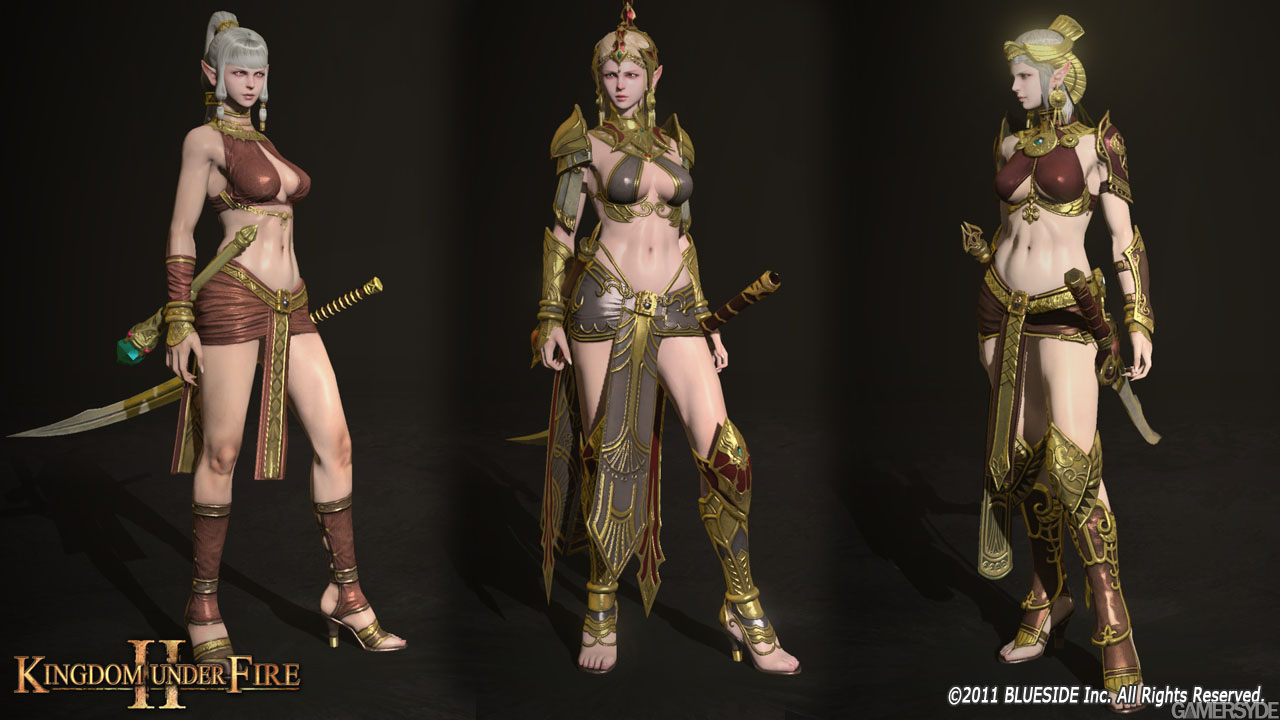
...

(You get the idea.)
So what does this have to do with me? Well, it’s hopefully easy to see how it can be hard to be taken seriously as a female gamer, and it’s something that has genuinely affected how I interact with strangers on the internet. “I promise I’m not trying to be provocative to get your attention, it’s just the way the developers made my armor, I swear!” When you’re constantly trying to reaffirm who you aren’t, it makes it hard to find out who you really are.

People don’t know about what I do in my free time just by looking at me, and most people never guess that I’m a gamer because I don’t fit into their image of what that is. In the real world, I don’t have to confirm to people that I’m just a normal girl, but that is flipped upside down in the digital world, and sometimes it’s emotionally exhausting.
See? Not a cave troll. No unibrow, sorry. :(
People don’t know about what I do in my free time just by looking at me, and most people never guess that I’m a gamer because I don’t fit into their image of what that is. In the real world, I don’t have to confirm to people that I’m just a normal girl, but that is flipped upside down in the digital world, and sometimes it’s emotionally exhausting.
Despite the drama involved in facing strangers and trolls in the vast expanse of the internet, I’m incredibly lucky to have a group of friends that I can game with so that I can avoid it. People sometimes see us as awkward geeks when we’re together, but I’m fine with that. If I need advice they’ll give it to me, and if I need a hand fighting that extra difficult final boss level, I also know they’ve got my back. We’re each other’s counselors and dungeon masters; drinking buddies and magic healers; confidantes and battle commanders.
I don’t see myself being a gamer girl forever. The average age of a gamer is 30, according to the Entertainment Software Association [source]. It’s time consuming, and as I start my career I foresee myself losing the time it takes to dedicate leveling up a character. The lessons I’ve learned and the friends I’ve made will surely stick with me forever though, and toughing it out through defending my identity has given me a new type of armor to wear in the form of my pride in being a gamer girl.
Works Cited
Chant, Ian. “It’s Time for a Serious Discussion About Boob Plate Armor.” Geekosystem. Mediaite, 7 May 2013. Web. 21 Apr 2014. <http://www.geekosystem.com/boob-plate-armor/>
"Chiptune." Last.fm. CBS Interactive. n.d. Web. 19 Apr 2014 <http://www.last.fm/tag/chiptune>
“Gaming.” Geek Feminism Wiki. Wikia. n.d. Web. 21 Apr 2014 <http://geekfeminism.wikia.com/>
Johnson, Stephen. “The Average Age of a Gamer is 30 Says ESA.” G4. G4 Media, 31 Jul 2012. Web. 19 Apr 2014. <http://www.g4tv.com/thefeed/blog/post/726494/the-average-age-of-a-gamer-is-30-says-esa/>
ladycroft3. “‘Fake’ Gamer/Nerd Girls and Why Geek Girl Shaming Needs to Stop.” Link Saves Zelda. n.p. Oct. 10 2013. Web. 21 Apr 2014. <http://linksaveszelda.com/2013/10/10/fake-gamernerd_girls-and-why-geek-girl-shaming-needs-to-stop/>
“The REAL Reason Men Play Video Games as Women.” Just Jill. n.p. 30 Jul 2010. Web. 19 Apr 2014. <http://justjillsblog.wordpress.com/2010/07/30/the-real-reason-men-play-video-games-as- women/>
(I apologize for indentation errors, formatting with Blogger is really frustrating. Copy and paste is futile.)
(I apologize for indentation errors, formatting with Blogger is really frustrating. Copy and paste is futile.)

No comments:
Post a Comment